Home » Dental Bone Graft
Bone Grafting for Dental Implants – Sinus Lift for Insufficient Bone
What Is a Sinus Lift Bone Graft in the Upper Jaw?
The term “sinus lift” comes from the Latin sinus maxillaris (maxillary sinus) and the English word lift. In this procedure, the floor of the maxillary sinus is lifted upwards — also referred to as sinus floor elevation.
But what exactly happens during this treatment?
The sinus floor is a thin bony plate separating the mouth from the maxillary sinus. The roots of the upper posterior teeth are typically located here. Chewing exerts natural pressure on the jawbone, which helps keep it strong and healthy.
This regular stimulation is essential for maintaining bone density. If teeth are missing — for example, due to decay or periodontitis — this stimulation stops. Without the pressure, the bone gradually recedes, particularly in the area of the sinus floor.
Over time, this leads to atrophy (bone loss). The longer missing teeth remain untreated, the more severe the bone resorption becomes. Eventually, there may not be enough bone left to place dental implants safely.
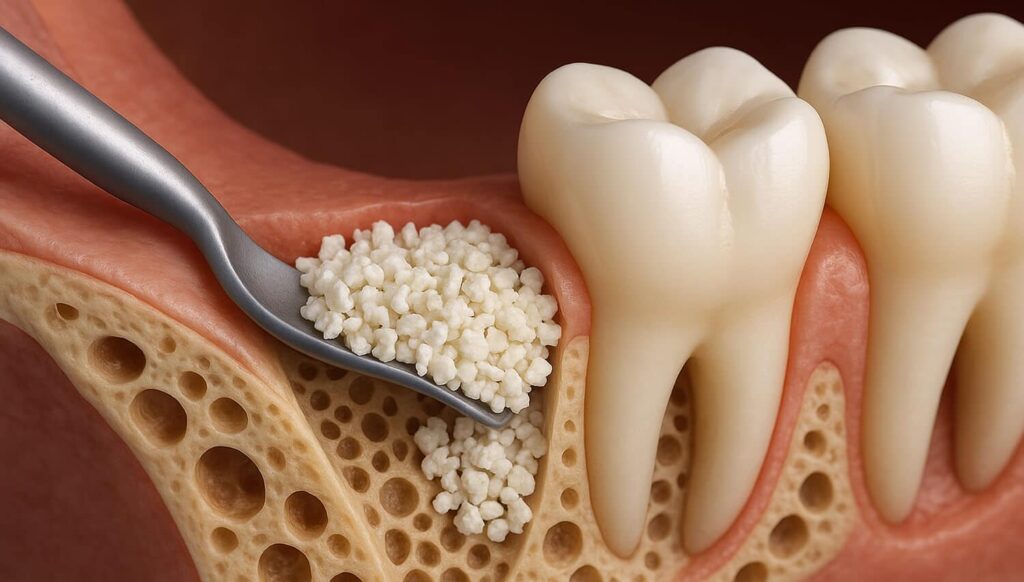
In cases of complete tooth loss, fixed restorations without implants are not possible. This is exactly where the sinus lift comes in — enabling implants to be placed even when bone volume is limited.
During the procedure, the bone is gently lifted or separated from the sinus floor and then filled with a bone graft material. The graft is placed between the sinus membrane and the sinus floor.
This material gradually integrates with the surrounding bone tissue and forms a stable foundation for dental implants. Once the graft has healed and solidified, the implantologist places the implant, which is later restored with a dental crown.
Who Needs a Sinus Lift?
To determine whether a sinus lift is required, a detailed diagnostic evaluation is performed using advanced imaging techniques. 3D X-ray scans (CBCT) show how much bone is available and whether it is sufficient for implant placement.
Ideally, an implant needs 1–2 mm of bone thickness around it and 9–10 mm of bone height. If this vertical or horizontal bone volume is missing — meaning the bone is too low or too thin — a bone graft is required to ensure secure implant anchorage.
Bone height in the upper jaw below 5 mm
Bone loss after tooth extraction or periodontitis
Planned implant placement in the posterior region (molars/premolars)
Frequently necessary in older patients or after long-term toothlessness
How Does a Sinus Lift Procedure Work?
First, the available bone is assessed in detail using CBCT imaging (digital volume tomography). This allows a precise 3D view of the mouth and jaw to determine exactly where a sinus lift is needed.
Next, the treating dentist or implantologist chooses the appropriate technique. There are two main types:
Internal (closed) sinus lift
The inner structure is crafted from metal for strength.
Procedure: Internal (Closed) Sinus Lift
Procedure: External (Open) Sinus Lift
Open vs. Closed Sinus Lift – What’s the Difference ?
| Method | Suitable For | Description |
| Closed (internal) sinus lift | ~5–8 mm remaining bone height | Access through implant site, minimally invasive, implant usually placed immediately |
| Open (external) sinus lift | < 5 mm remaining bone height | Access through lateral sinus wall, larger graft volume, implant placed after 4–6 months |
| Open sinus lift with graft | Very low bone volume, complex cases | Combination of graft materials, longer healing time, highly stable results |
How Much Does a Sinus Lift with Bone Grafting Cost in Turkey?
| Treatment | England (avg.) | Turkey with Fly2Smile (avg.) |
| Closed sinus lift | £425–£765 | £85–£170 |
| Open sinus lift | £1,020–£1,530 | £210–£255 |
| Open sinus lift with graft | £1,275–£1,870 | £380–£470 |
| Dental implant (per implant, after healing) | £1,530–£2,125 | £255–£680 |
| 3D X-ray diagnostics | £170–£340 | Included |
| Bone graft material | £255–£425 extra | Included / part of package |
| Hotel & transfers | – | Included |
| Total (avg.) | Up to approx. £4,250 | From approx. £850–£1,530 |
Benefits of Bone Grafting with Fly2Smile

Autograft (patient’s own bone)
Allograft (human donor bone)
Xenograft such as Bio-Oss® (bovine bone)
GBR membranes (guided bone regeneration) such as Bio-Gide®
Synthetic materials (alloplast)
Or combinations of the above
We rely on cutting-edge digital planning and diagnostics for 3D scans and CBCT imaging, allowing precise planning of your sinus lift. Our clinics are fully equipped with the latest technology.
To make your experience as comfortable as possible, we offer all-inclusive packages including flight arrangements, hotel accommodation in 4- or 5-star hotels, a English-speaking coordinator, and all transfers between airport, clinic and hotel.
Form ENG
"*" indicates required fields
Frequently Asked Questions
Is a sinus lift painful?
How long is the healing period?
The healing period for an implant after a sinus lift is typically between four and six months. Depending on individual healing and the quality of the existing bone, this timeframe may vary. If sufficient bone is present, the sinus lift can, in some cases, be performed at the same time as implant placement.