Home » Dentures
Dentures – Everything You Need to Know About Tooth Replacement
Large tooth gaps or completely toothless jaws can be extremely distressing for affected patients, often leading them to immediately consider various forms of dental restoration.
While dental implants are a suitable option for many, they are not ideal for everyone. Implant-supported dentures, for example, cannot be placed in cases of severe bone loss.
In addition to implants, there are many different types of dentures. Which option is suitable for you depends on the condition of your gums, the remaining natural teeth, your individual circumstances, as well as your expectations regarding aesthetics and comfort.
Here, you will learn what dentures are, which types exist, who they are suitable for, which costs to expect, and the benefits they offer.
What Is a Denture ?
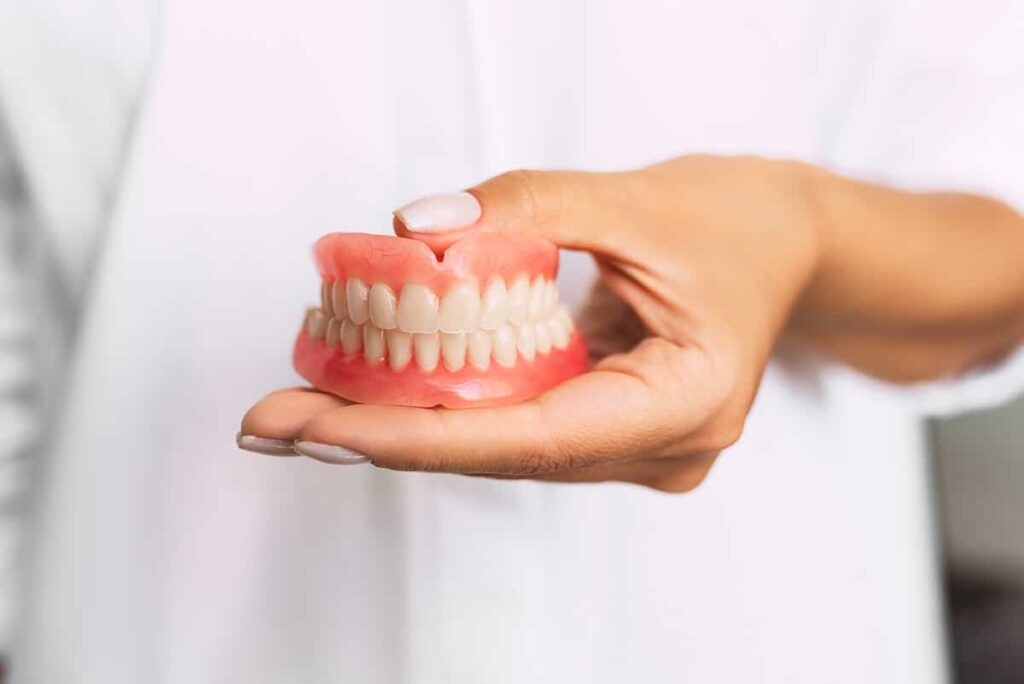
Partial Dentures
Partial dentures are attached to existing natural teeth. They replace one or several neighbouring missing teeth.
Full Dentures
Full dentures are used when few or no natural teeth remain in the upper or lower jaw. Completely toothless jaws are a common reason to choose a full denture, which restores an entire arch of teeth.
Unlike implants, dentures do not require artificial tooth roots, meaning no invasive surgery is needed. There is no bone augmentation required, and denture wearers can easily remove and clean their prosthesis under running water.
What Types of Dentures Exist ?
| Type | Suitable For | Characteristics |
| Partial denture | Several missing teeth | Removable denture with clasps or bars |
| Full denture | Toothless upper/lower jaw | Full prosthesis resting on the gums |
| Telescopic denture | Remaining teeth or implants | Combines fixed and removable elements |
| Interim denture | Temporary solution during treatment | Simple and cost-effective |
Who Is a Denture Suitable For?
Severe tooth loss, such as toothless jaws or insufficient bone structure
Cases where no anchoring options for a dental bridge are available
Temporary solutions until implant placement is possible
Patients with fear of surgery or dental anxiety
Older adults who prefer easy cleaning and everyday usability
How Much Do Dentures Cost in Turkey?
| Type of Denture | England (avg.) | Fly2Smile Turkey (avg.) |
| Partial denture (1 jaw) | £700 to £1,300 | £340 to £680 |
| Full denture (1 jaw) | £900 to £1,700 | £425 to £850 |
| Telescopic denture | £2,600 to £4,300 | £1,020 to £1,700 |
| Hotel and transfers | – | included |
| Flight and travel | – | approx. £170 |
| Total (avg.) | Up to approx. £4,300 | From approx. £510 to £1,900 |
Benefits of Dentures with Fly2Smile

Our laboratory, which fabricates your denture, works with highly skilled dental technicians and uses only premium materials — ensuring your prosthesis looks indistinguishable from a natural tooth. Aesthetics and appearance are our top priorities.
During your stay, you will have a personal German-speaking coordinator by your side — from consultation to aftercare — ensuring no language barriers and that your needs regarding your removable denture are fully met.
Fly2Smile offers attractive all-inclusive packages that cover your travel, flights, all transfers, and accommodation in luxurious 3- to 5-star hotels. This means you can focus on enjoying your stay and exploring the beautiful city.
Compared to England, dentures from Fly2Smile are significantly more affordable.
Partial dentures are around 48% cheaper
Full dentures are around 50% cheaper
Telescopic dentures are up to 60% cheaper
Even when including hotel, transfers, and travel costs, patients save an average of 44%.
Form ENG
"*" indicates required fields